
I discussed Dispensationalism and its theology in the previous posts. But here is an important part of the story.
There is also a reason why this framework has found particularly fertile ground in the American context.
This instinct has deeper roots than we might first assume. From its earliest days, many of the first English settlers in America understood themselves through a distinctly biblical lens. Drawing heavily from the Old Testament, they saw their journey in terms of a new exodus—a people set apart, entering into a kind of promised land. Their language reflected this imagination: towns were named Salem, Bethel, and Zion; children after patriarchs and prophets; and the life of the community was often framed in covenantal terms. This was not yet dispensationalism—but it established a pattern of reading Scripture in a way that closely aligned the identity and destiny of a people with the unfolding purposes of God in history.
That instinct did not disappear. It evolved.
Over time, it was reinforced and carried forward through the movements and institutions that came to shape American religious life. Revival preaching, popular teaching, and later the wide circulation of study Bibles and prophecy frameworks brought increasingly defined systems into the everyday imagination of ordinary believers. What began as a broad biblical lens gradually took on sharper contours—retaining its national and historical focus, now coupled with a growing sense of prophetic expectation.
Dispensationalism thus entered a landscape already primed to think in national and biblical categories. And as it did, it found resonance with a developing sense of American moral and civilizational exceptionalism—the idea that the nation stands as a unique force for good, a beacon of order, liberty, and even righteousness in the world.
A theological framework that already leans toward reading biblical promises in national and geopolitical terms was thus quietly fused with this national self-understanding. The result is a subtle but powerful shift: the purposes of God begin to feel aligned with the trajectory of a particular nation.
And once that connection is made, it becomes very difficult to disentangle theology from political identity.
America is no longer simply a country—it begins to be imagined as an instrument of redemptive history. Its actions take on a moral weight beyond ordinary political judgment. Its conflicts begin to mirror the categories of Scripture.
At that point, the lines begin to blur. The overlap does not remain theoretical—it begins to shape how actions are described and justified.
Consider how the language of spreading the Gospel and the language of spreading democracy take on similar patterns. A call to advance a particular political order imperceptibly takes on the weight of the Gospel.
In much of the post-war period, the conflicts in which the United States has engaged have been framed in stark moral terms—good versus evil, freedom versus oppression. There is, of course, truth in recognizing evil in the world. But when those categories are adopted wholesale and invested with near-theological certainty, they begin to function less like careful moral judgment and more like unquestioned doctrine.
What emerges is not merely foreign policy, but a kind of moral narrative—one that bears an uncomfortable resemblance to the language of redemption itself.
America’s purpose quietly becomes perceived as God’s own purpose.
And the results are both damaging and, sadly, predictable.
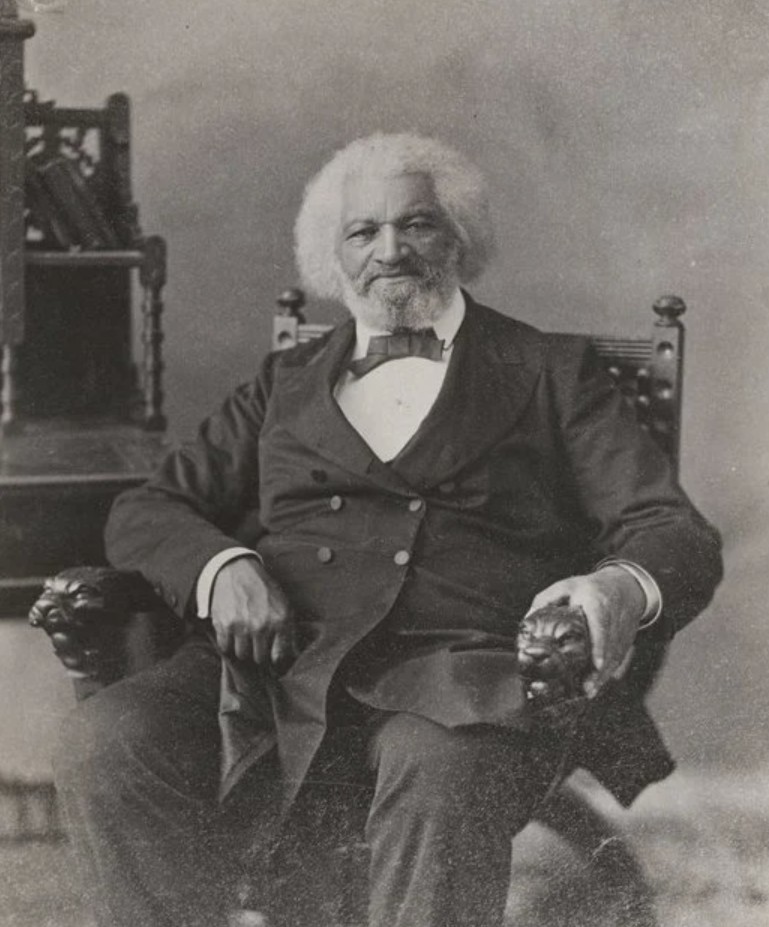
Frederick Douglass once observed, “of all slaveholders with whom I have ever met, religious slaveholders are the worst.”
The point is not rhetorical—it is deeply instructive.
“Religious” is the operative word.
It describes not Christianity rightly understood, but a hardened posture shaped by a distorted reading of Scripture—one that produces certainty without humility, conviction without charity, and action without restraint.
A person convinced that he is reading the will of God plainly and without error will act accordingly. In the case of slavery, once the prevailing teaching took hold—that God had ordained bondage for African men and women—the conclusion followed naturally.
That conviction itself rested on a similarly flattened reading of Scripture: taking laws and categories given to a specific people, in a specific time, and extending them beyond their context—using them to normalize and justify an institution never intended as a universal moral good. Once that reading was accepted, harshness was not an aberration—it was the natural outworking of the belief.
And we are witnessing a very similar dissonance all around us today.
Millions of professing evangelicals are confronted with the harshness of this administration across multiple fronts—both in rhetoric and in action—and yet the response is often not pause, nor sober reconsideration, but a doubling down.
Go to war? Then it must be justified—after all, the enemies of the moment are readily mapped onto the enemies of Scripture.
Use force against protesters? Then the fault must lie with those who resisted—surely they must stand on the wrong side of what is good and right.
Dismiss entire groups of people? Then their voice is easily set aside—again, presumed to be aligned with what is opposed to truth.
These are simplified examples, but they reflect a real pattern.
Yet Scripture is not the problem.
Bad doctrine is.
Sound doctrine transforms the mind. Such a mind is not hardened, but made lowly and teachable—marked by meekness, restraint, and a willingness to be corrected. It does not seek to assert itself through the mechanisms of power, nor to clothe political ambition in the language of faith.
This stands in stark contrast to much of what passes for American evangelicalism today.
And the consequences are not limited to public life.
The havoc left in society and in international affairs is real—but the deeper loss is spiritual. A mind convinced it sees clearly, when it does not, is exceedingly difficult to correct. “If therefore the light that is in you is darkness, how great is that darkness!” (Matthew 6:23)
How far this distortion will run, only time will tell. But history gives us reason to be sober.
God is not indifferent to the misuse of His Word.
Nor does He leave His Church untouched by it.

 Pared To Truth
Leave a comment