
Fascist Past — Croatia’s Political and Cultural Schizophrenia
A few of you have reached out to say you’ve been reading my posts (and comments) about Croatia’s fascist-sympathizing singer—and the government’s chronic unwillingness to sanction him in any meaningful way. This is a summary of my reflections in the wake of yet another public spectacle (his recent concert) where these festering issues once again took center stage.
Croatia’s struggle with its WWII legacy goes far beyond the popularity of one man. But for better or worse, Marko Perković—better known by his stage name Thompson—has become the clearest embodiment of a worldview that, for the past 30 years, has sought to rehabilitate the fascist era of Croatia’s past as a legitimate, even noble, chapter in its national struggle for independence.
The result? A deeply confused generation—one that, like the idol they revere, publicly denies any ties to fascism while donning outfits styled after NDH-era uniforms (right down to the cut, color, and insignia) and chanting slogans functionally identical to “Heil Hitler.” This is standard fare at every Thompson concert.
Now add to this the fact that, in 1990, modern Croatia adopted a national flag that is—save for the emblems—nearly identical to that of the NDH. It quickly becomes clear just how easy it is to exploit fascist sympathies while cloaking oneself in the respectable garb of “patriotism.”
Side-by-side comparison of the modern Croatian flag and the NDH (1941-45 fascist) flag
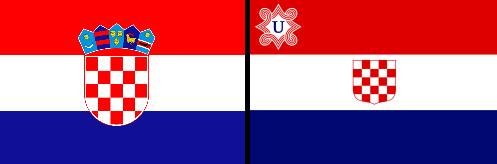
The NDH—Croatia’s short-lived WWII puppet state under Hitler—has been gradually rebranded from a cautionary tale into a nationalistic touchstone.
Through selective memory, downplaying of crimes, and glorification of symbols, the NDH has been sanitized in the public imagination.
Government officials, of course, like to point to the Croatian Constitution, which affirms that the modern state is founded on anti-fascist principles and explicitly distances itself from the NDH.
…and apologists love to parachute in with, “That flag predates WWII—it has nothing to do with fascism!”
The first part is true. But a two-year-old could tell you that what something once was no longer matters after it’s been irredeemably marred by fascist use.
So then you look at the flags. And the concerts. And the silence.
And what you’re left with is the classic Croatian shrug. Are you Croatians fascist sympathizers?
“Jesmo pa nismo!”
(“We are, and we are not!”)
📝 Jesmo pa nismo: The Croatian Doublethink
This phrase—“Jesmo pa nismo” (“We are… and we are not”)—has become shorthand for Croatia’s political and cultural schizophrenia when dealing with its fascist past.
It’s the perfect slogan for a generation that wants the pride of WWII-era nationalism without the shame of fascism, the aesthetic of defiance without the moral responsibility.
They’ll shout “Za dom spremni!” at concerts then clutch the Constitution when questioned.
(“For the homeland—ready!”—a slogan used by the WWII fascist regime as a military salute, at concentration camps, in official decrees, and on propaganda posters…)They’ll sing about “Bog i Hrvati” then feign offense when someone brings up the NDH.
(“God and Croats”—another slogan tainted by the WWII regime. By claiming to defend Catholic Croatia from Serbs, Jews, and Communists, invoking God alongside national identity became strategic: it baptized their violence.)So… “Jesmo pa nismo” isn’t just a phrase.
It’s a strategy.
A smokescreen.
A national shrug wrapped in a flag.
Thompson’s popularity has only surged. His last concert drew a crowd of 500,000—an enormous source of pride for his followers. But for those who’ve managed to retain a functioning moral compass through decades of whitewashing and historical revisionism—a source of deep shame.
Naturally, a few of these Thompson-related posts caught my eye. So I said—again—what needed to be said. I called it out.
The Facebook algorithm ‘rewarded’ me by dropping me into the feed of one @SteveRavic—Thompson’s international agent and, judging by his online activity, his de facto apologist-in-chief. He appeared rather suddenly, and despite his profession of being “well researched,” offered no new answers—just the usual deflections and attempts at discreditation, eventually “threatening” with a press release from the singer’s legal team.
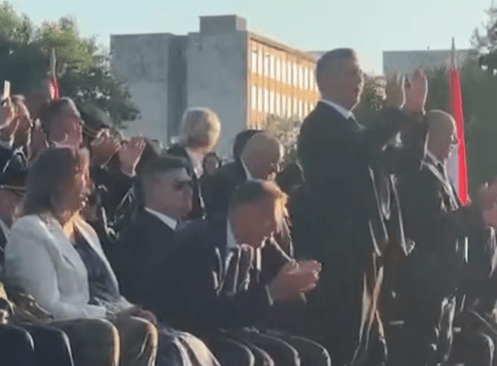
Croatian Prime Minister Andrej Plenković clapping and dancing to Thompson’s song during the recent military parade in Zagreb, as President Milanović quietly walked out.
You can read the whole exchange here, but the long and short of it is this: Steve regurgitated the usual excuses—why “Za dom spremni!” has nothing to do with the fascist NDH (essentially because those using it today supposedly don’t mean it that way), why Thompson is not a Nazi sympathizer, and how any criticisms of either are simply the product of ignorance, ideological bias, or a failure to appreciate Croatia’s struggle for independence.
And since—along with his 80s glam-era hairstyle and costumes—Steve also takes pride in rummaging through people’s Facebook posts for “discrediting” material, he concluded that my satirical face-swaps with Tito, Elvis, and Churchill gave him enough of a leg to stand on. From there, he launched into the tired, one-size-fits-all defense his cohort always reaches for whenever confronted by critics from the former Yugoslavia: that pinnacle of originality—that I am under the sway of “Titoist,” “Communist,” and “Yugoslav propaganda.”
For my part, I posed two simple questions—repeatedly and pointedly. Very straightforward questions, but you’d think I’d asked him to recite the phone book in reverse. He ignored them entirely, staying quiet as a church mouse—quiet like a child caught in a lie, hoping invisibility might come if he just didn’t move. His silence wasn’t surprising, though. It’s exactly what his idol has done for decades when faced with pointed objections: deflect, deny, and play innocent. Here are the questions in bold, with my comments in italics for clarity:
- What does the slogan ‘Za dom spremni!’ (“For the homeland—ready!”) mean to the descendants of those murdered between 1941 and 1945 by the genocidal NDH regime?
–Thompson continues to use a slogan directly tied to fascist genocide and banned throughout the civilized world. My question was prompted by Steve’s own rather vulgar and aggressive use of the slogan in one of his replies to me—followed, of course, by the infamous explanation: essentially that “it isn’t fascist because those who use it today don’t mean it that way.” - The number 03941158 on Thompson’s shirt—a known reference to a convicted Ustaša (fascist) hijacker and murderer. Why was Marko wearing this number?
–If Marko is ever pressed to address this point (and, given the photo evidence, it’s a difficult one to wiggle out of), I predict we’ll get something along the lines of: “These aggressive communists and Yugo-indoctrinated folks who’ve been smearing me for decades pushed me to do it. I was provoked!”
You see, in Croatia today, almost anything can be excused—and even legalized—if you claim it was done in response to communist or Serbian aggression of the 1990s.
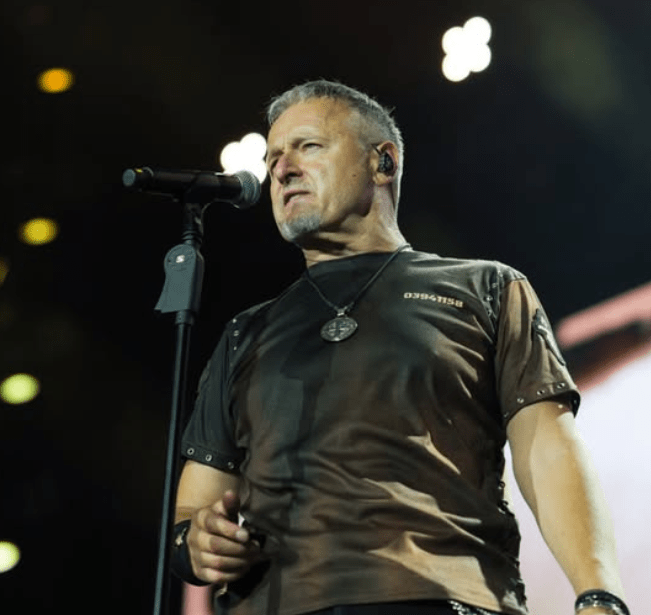
As mentioned, Steve never answered these questions. Not once.
But what followed was even more telling: a press release.
The “Demanti”: A Legal Puff Piece Posing as Rebuttal
According to a statement published in Narod.hr, Thompson’s lawyers (Mateković & Partneri) issued a communiqué to foreign agencies—AP, AFP, Reuters—claiming that accusations of Nazism are “untrue and insulting,” both to him and to his fans (!). They assert:
- Čavoglave, the song that opens with “Za dom spremni!”, was written during Croatia’s war for independence and is not linked to fascism.
- A Croatian court ruled that the chant is legal in that context.
- Thompson and his team “denounce all forms of totalitarianism.”
- If defamation continues, legal action will be pursued in Croatian courts.
And that’s it—the entirety of their defense. So let’s address it with the clarity and substance they worked so hard to avoid:
1. “Za dom spremni!” is part of a wartime song, not fascism.”
A misdirection visible from the moon. “Za dom spremni!” was the official salute of the Ustaša regime—used at concentration camps, printed on propaganda, shouted by soldiers. Its use today carries no ambiguity; it is a historical dog whistle. The fact that it was baked into a war-era song (Čavoglave) in the 1990s doesn’t neutralize its meaning—it merely repackages it for nationalist consumption.
No amount of rebranding turns a hate-tainted slogan into a patriotic flourish. It was wrong to use it then, and it is just as wrong to continue using it now.
2. “A Croatian court says it’s legal.”
Ah yes—the gold standard of moral clarity: a domestic court under political pressure.
The Croatian ruling they cite was a concession to public sentiment, not a principled stand. “Za dom spremni!” remains banned in most of Europe and condemned by historians across the spectrum. Pointing to that ruling as justification is like asking post-war Germans if “Sieg Heil!” should be allowed—then making the Waffen-SS the jury. Legal doesn’t mean moral. It means expedient.
3. “We denounce fascism.”
No, you don’t. Because if you did, Thompson wouldn’t:
- Begin Čavoglave with a fascist chant.
- Wear a shirt marked 03941158—a direct reference to an Ustaša plane hijacker and convicted murderer.
- Stand before crowds that chant Nazi-era slogans while draped in NDH-era insignia—without ever addressing it.
A real denouncement requires a clear public disavowal. Not a vague sentence buried in a press release. Not silence when it matters most.
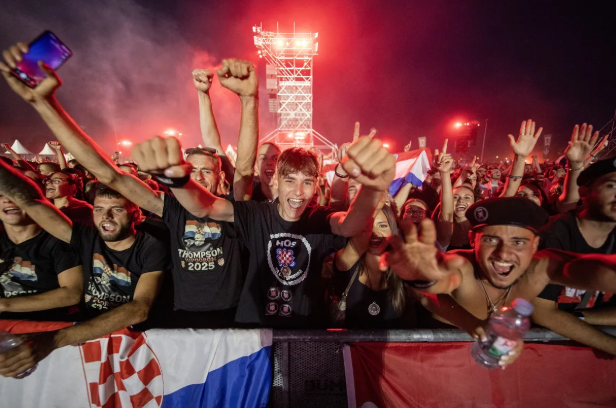
4. “These accusations insult our audience.”
Here, the demanti almost slips into self-parody.
The problem isn’t the substance of the critics’ words — it’s the notion that this crowd, half a million strong, should be seen as willing participants in cheering a man who romanticizes the darkest chapters of Croatian history. Get it?
If you’re offended by being called out for tolerating fascist nostalgia, maybe the solution isn’t to silence the critics.
Maybe the solution is to stop peddling fascist nostalgia.
When Christ Is a Flagpole: The Christian-Patriotic Masquerade
Even more troubling than the legal posturing is the aggressive co-opting of Christianity to sanctify this ideological poison. And while I’d be lying if I said I wasn’t at least a little delighted to see more “Christian” garb at Thompson concerts—because hiding behind a façade of godliness only exposes them to the full weight of Scripture aimed squarely at such pretense—the trend is deeply sickening.
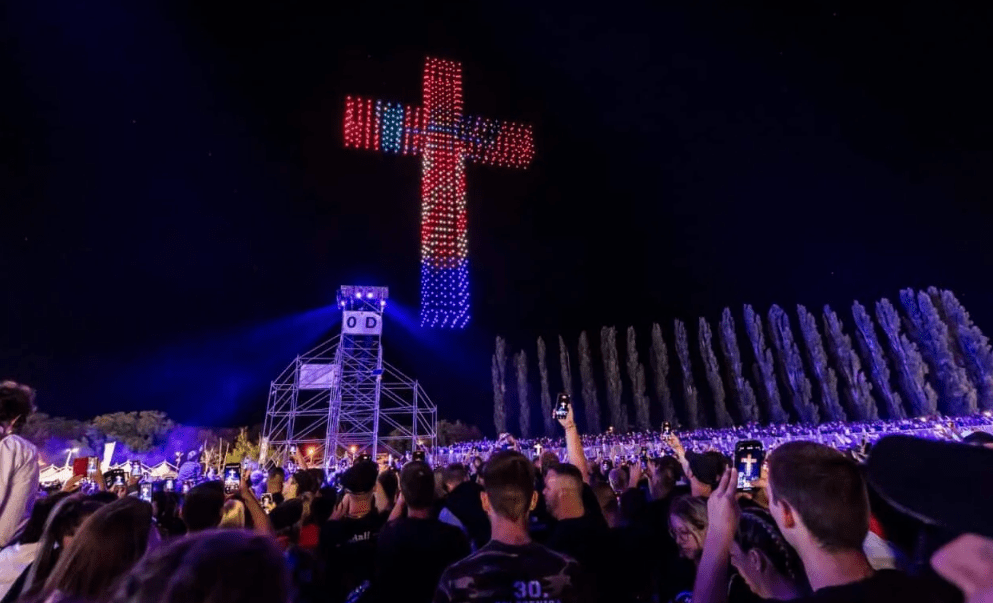
At these concerts, the Croatian checkerboard becomes a cross. Drone displays form images of (Catholic representations of) Mary. Songs like Neću izdat ja, Boga nikada (“I’ll never betray God”) are woven into the setlist. And fans speak of Bog i Hrvati (“God and Croats”) as though it were gospel.
I originally intended to spend most of this section highlighting the scriptural inconsistencies of what some now call a “movement.” But let’s be real—this charade deserves none of that. Instead, a few plain questions will do:
- What Bible are they reading?
- Which translation of Scripture condones slogans marred in genocide?
- Which Gospel fuses national pride with divine favor?
- Where in the Scriptures does Christ endorse stoking ethnic grievance in His name?
Just consider the following few verses, for example.
“And the second is like it: ‘You shall love your neighbor as yourself.’” — Matthew 22:39
“We give no offense in anything, that our ministry may not be blamed.” — 2 Corinthians 6:3
“Abstain from all appearance of evil.” — 1 Thessalonians 5:22
If this “movement” were leading its adherents toward godliness, they would not be clinging to slogans that cause righteous offense to so many. The mere appearance of impropriety would send them running. Godliness does not parade as national pride; it does not chant war cries under the guise of faith. If these gatherings were truly celebrating godliness, the opposite would be echoing through their speakers:
“Love your enemies!”
Yes—love your Serbian brothers and sisters.
Imagine that for a moment! …and you’ll instantly see just how far from godliness this throng really is.
Yet here they are—clinging to “Za dom spremni!” as if it were sacred liturgy. Never mind the offense it causes to tens of thousands of Croatian citizens and the wider region that still bears the scars of the regime that coined it.
Legal rulings aside: the deliberate, sustained offense of your neighbor isn’t just a spiritual failure—it’s moral collapse that no number of drone-mounted crosses or Marys can redeem.
If They Were Truly About Christ…
Again, if this “movement” were about God, their conscience would have been stirred decades ago. The slogans would have ceased. The shirt numbers never worn. The chants silenced.
But this is as far from Christ as the east is from the west. It isn’t mere grievance — it’s grievance weaponized to intimidate, a cloak for hate, blame, and pride, all masquerading as faith and patriotism.
That’s why every critic is met not with humility, but with vulgarity—and attempts to discredit not the argument, but the person. My own exchange with @SteveRavic showed as much, yet again. Instead of honest replies, I received character smears, whataboutism, false accusations, and eventually—legal threats. Meanwhile, the Thompson faithful flooded in with insults, slurs, and more “Za dom spremni!” chants. Sickening.
But if you think this was a one-off, I could post a list of links longer than a freight train. I’ve been calling out this shame on forums for years. Here’s just one of the more revealing ones: Zoran Pusić, a Croatian politician and human rights activist was recently chased from a memorial service by an ex-Croatian general—for daring to mention, in his speech, that it wasn’t the Serbs killing innocents at that particular site. (I interacted in Croatian, but browser translations are good enough these days for English speakers to follow along: Note the vulgarity and aggression by those commenting in approval.)
The fruit of this tree is rotten.
No legal release can whitewash that.
Let the Books Be Opened
Thompson may hide behind court rulings, press releases, and curated stage shows. But history will record what he chose to glorify—and what he refused to renounce.
And more importantly, God will judge not the stagecraft, but the heart. That judgment will depend, in no small part, on how we treated our neighbors.
“Not everyone who says to Me, ‘Lord, Lord,’ shall enter the kingdom of heaven…” — Matthew 7:21
“And the second [greatest commandment], like it, is this: ‘You shall love your neighbor as yourself.’” — Mark 12:31
So let them sing. Let them dance. Let them shout their profane version of patriotism, wrapped in denial—slashing anew the wounded hearts across the region with every chant they utter.
Just know:
The books will be opened.
And at the Final Judgement, the court will not cave to pressure.
____
Oh, and to be clear: as someone of Croatian descent, I take no pleasure in calling out a legacy so badly stained by moral rot.


Leave a Reply