
On Confidence, Authority, and Speaking of God’s Word
There are few things more dangerous in public life than a man who mistakes his platform for wisdom. History is full of them. The Pharisees had it. The medieval scholastics who weaponized Scripture for politics had it. The 20th-century ideologues who wrapped their propaganda in moral language had it. And now, in our own digital marketplace of opinions, the same old temptation returns in a new form: the pundit who believes his ability to speak confidently about everything qualifies him to speak about God. The “I yap; therefore I know” mentality is all around us.
This is not a new problem, but it is newly visible. We live in an age where people no longer differentiate between volume and authority—where someone who “opines for a living” can slide seamlessly from cultural and political commentary into theological declaration without ever pausing to consider whether he understands the ground he now stands on. Men with microphones have always mistaken the microphone for truth. Today they simply do it in HD.

Which is why the spectacle of Tucker Carlson doing theology on camera—with the same cadence he uses to sell his nightly stream of racialized outrage—is not merely absurd. It is reckless, spiritually and otherwise. He carries intellectual clout, but it is clout folded inward: self-aggrandizing and self-validating.
These public figures eventually stumble into the same trap: “I am so smart, I can even speak about God—and people will listen.”
Pride comes before the fall.
Scripture is not a neutral artifact, nor a rhetorical tool to be picked up at convenience. To invoke it publicly is to place oneself under judgment, not above one’s audience.
Leaders who anchor their message in Scripture do so at their own risk, because its authority does not bend to charisma or confidence. Spoken carelessly, it flatters the speaker; spoken with restraint, it humbles him first. That difference matters—and history shows it.
Speaking to the nation near the conclusion of the Great Conflict, President Lincoln delivered 700 words without fanfare, without boisterous finger-wagging, and without a hint of a vengeful spirit—though he would have been more than justified. In true Lincoln cadence, so understated in delivery and so anti-climactic in tone, many Northerners were reportedly disappointed at first, having expected a far harsher stance toward the Confederacy.
When given the opportunity, he chose to use Scripture with great sensitivity and with such aptness to the occasion that few pastors and theologians have matched his insight and clarity on the subjects of American slavery, the Civil War, and God’s counsel for those difficult chapters in our nation’s history.
Listen to the echo of those 700 words across the decades and the centuries that have passed since. We rightly revere them.
Said Lincoln of the warring parties:
“Both read the same Bible and pray to the same God, and each invokes His aid against the other. It may seem strange that any men should dare to ask a just God’s assistance in wringing their bread from the sweat of other men’s faces, but let us judge not, that we be not judged.
The prayers of both could not be answered. That of neither has been answered fully.
The Almighty has His own purposes. ‘Woe unto the world because of offenses; for it must needs be that offenses come, but woe to that man by whom the offense cometh.’
If we shall suppose that American slavery is one of those offenses which, in the providence of God, must needs come, but which, having continued through His appointed time, He now wills to remove, and that He gives to both North and South this terrible war as the woe due to those by whom the offense came, shall we discern therein any departure from those divine attributes which the believers in a living God always ascribe to Him?
Fondly do we hope, fervently do we pray, that this mighty scourge of war may speedily pass away.
Yet, if God wills that it continue until all the wealth piled by the bondsman’s two hundred and fifty years of unrequited toil shall be sunk, and until every drop of blood drawn with the lash shall be paid by another drawn with the sword, as was said three thousand years ago, so still it must be said: ‘the judgments of the Lord are true and righteous altogether.’
With malice toward none, with charity for all, with firmness in the right as God gives us to see the right…”
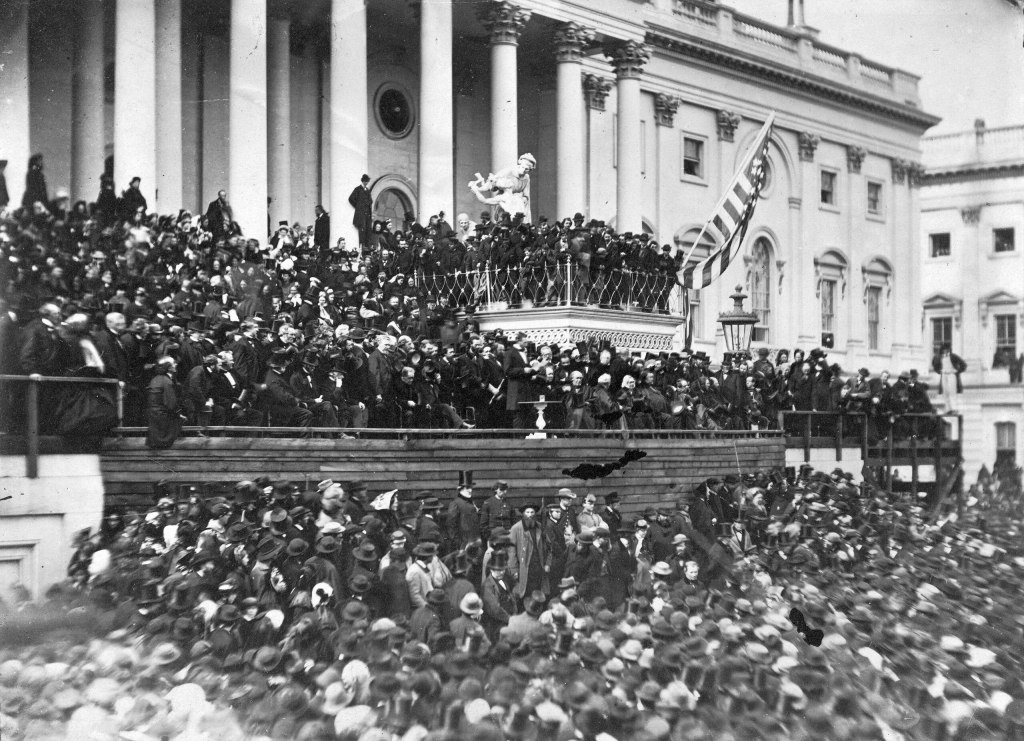
All presidents have their clout and power, along with their personal philosophies—and the philosophers whose doctrines they help promote, normalize, and establish. Many like to quote Scripture, but not many are capable of framing their entire message around it as Lincoln did—certainly not on one of the most difficult subjects, at one of the most pivotal moments, speaking reconciliation rather than division, and doing so with such grace and precision.
Trump, for all his flaws, delusions, and bombastic pretense, rarely engages theology head-on. Somewhere in the back of his mind he knows he doesn’t have the tools. When he quips that “smart people don’t like me,” it’s tragic—almost pathetic—but it does signal a flicker of self-awareness, one genuinely at odds with his public persona. He intuitively understands he is out of his depth when the conversation moves from grievance to doctrine.
The problem is that leaders like this rarely arrive alone. They come with ideological whisperers in tow. Those versed in reading between the lines—though by now hardly a secret anymore—know Trump’s ideological godfathers: Carlson, Bannon, and Hannity.
You could call them Trump’s ideological “unholy trinity”—each playing a different instrument in the same discordant choir.
Bannon postures as a civilizational warrior, invoking the “Judeo-Christian West” while drafting mental battle maps for his twisted visions of a coming Armageddon—the lines drawn, no doubt, along the racial and cultural divides his superficial mind champions.
Hannity, meanwhile, simply lacks the intellectual wattage to venture far into theology; his instincts remain rooted in self-promotion, fleecing the evangelical sheep, and keeping alive Fox’s vision of an “America First” doctrine—which needs only the occasional Scripture verse to keep the base stirred.
Tucker does not share that self-preserving instinct.
Tucker walks into theological territory with the same swagger and smugness he brings to political commentary. He speaks as if “insight” were transferable simply because the camera is already rolling. He trades not on humility, but on intellectual vanity dressed up as revelation.
And that is why his theological posturing is not merely wrongheaded—it is corrosive.
Bad theology, when spoken with confidence, is more destructive than no theology at all. And that is especially true now, because so many within the “evangelical flock” have become so diluted and invested in MAGA/Trump Christianity that some of these brothers and sisters of ours are genuinely no longer able to discern between Fox News and the Sermon on the Mount. Truly.
Bad spiritual leaders and their misuse of spiritual doctrine were precisely what made Jesus angry.
“But wait,” you say, “Tucker is not a spiritual leader!”
And you say that rightly — he isn’t even close to one.
No — I’m afraid far too many have been overcome by the polished look and the slithery words that lurk nightly, just a click of the remote away. Never mind a swipe away at any hour of the day.
Long gone are the days when most evangelicals looked to their pastors, theologians, and the historic teaching of the Church to anchor their understanding of Scripture.
Long gone, too, is the most basic form of discernment — the instinct to distrust men with microphones and instead test all claims against the pages of Scripture, as taught and guarded by the faithful stewards of the Church.
In the actual gospel accounts, Jesus never directs His wrath toward sinners. Not once. He admonishes the adulterous woman without anger: “Go and sin no more.” He brings salvation to Zacchaeus without condemnation. He reveals Himself gently to the Samaritan woman.
But the hypocrites who presumed to know God’s law and precepts? Those who used Scripture as a weapon or a means of gain while remaining blind to their own hearts? You know it.
Every recorded moment of Christ’s anger is directed at false teachers — the men who presumed to speak for God while distorting Him.
“Woe to you, scribes and Pharisees, hypocrites.”
“You shut the kingdom of heaven in people’s faces.”
“Blind guides.”
“Whitewashed tombs.”
“A brood of vipers.”
Christ saves His fiercest language not for moral failure or “observable” sin, but for the corruption of truth — because bad theology spoken with confidence doesn’t merely misinform; it misleads souls.
Trump’s ignorance is visible. Tucker’s arrogance is seductive. Trump exploits the faith of the gullible; Tucker affirms and cultivates their pride in thinking they see more clearly than everyone else. One is shallow manipulation; the other is idolatry of the mind masquerading as insight.
And this is where my own instinct comes in. People sometimes wonder why I pounce so hard when a public figure starts dabbling in theology as if they’re offering just another political take.
The answer is simple: because we are all like sheep. Most people are undiscerning and easily led. It’s what has repeatedly allowed destructive movements to gain political power throughout history. So when someone with influence presumes to interpret Scripture with the aura of “I talk for a living, therefore I know,” I pounce.
I pounce because false certainty is contagious — just look at the MAGA movement and its evangelical base.
Yes, there are far too many “political” pastors out there — some even reasonably Christ-centered at 10am on Sunday, yet fiercely MAGA by barbecue time.
But the truth is this: most evangelicals did not learn this kind of devotion to such bad doctrine in church.
So I don’t pounce for smoke.
I pounce because I know silence can be interpreted as complicity.
The modern Pharisee is not the man who sins. It is the man who, mistaking confidence for calling, weaponizes distorted doctrine and lends it the seductive appearance of truth.
This is why I speak.
This is why I engage.
This is why I pounce.
Because Scripture is holy ground — not a stage for punditry. And if a man tries to turn theological discourse into yet another vehicle for his brand of grievance, vanity, self-anointed insight, stirring patriotic fervor, or any form of political gain, it is on all of us — who have been given a measure of light — to say so. Not for argument’s sake, but for the sake of those listening.
Bad theology spoken with confidence has always been the most dangerous kind.
Jesus Himself made that clear.
And we would do well to remember it.

 Pared To Truth
Leave a comment