
Would your church receive George Washington or Thomas Jefferson into membership?
The Fourth of July is here, and it is not a bad thing for a nation to remember its beginning.
Nations, like men, forget easily.
We forget the cost of things. We forget the blood beneath our comforts. We forget the contradictions buried under our slogans. We remember what flatters us and quietly neglect what condemns us.
It is good to remember courage, sacrifice, political genius, and the astonishing achievement of founding a republic that, in time, would become one of the great powers of the earth.
But let us also remember clearly.
Because there were hundreds of thousands already in this land for whom July 4th, 1776 brought anything but freedom. Millions more would be born into the same bondage before the nation was forced to answer, at least in part, for what it had tolerated from the beginning. Their freedom would not come for another four score and seven years — and not even then without blood, fire, sword, proclamation, amendment, military victory, and the long bitter aftermath.
It is here that patriotic memory often turns sentimental.
We speak of liberty, providence, founding principles, and the men who built the frame of the republic. We speak of them as giants, and in some respects they were.
But the question is not whether compromised men can accomplish consequential things. History is full of such men.
The question is whether we have the moral clarity to name the compromise.
The original Constitution did not create a fully free republic. It created a republic that made political room for slavery. It counted enslaved persons for representation while denying them liberty. It protected, for a time, the importation of human beings. It required the forcible return of those who escaped bondage.
One may call this political compromise. That is not entirely wrong. Republics are often born by compromise; that is part of the ordinary machinery of political life in a fallen world.
But Christians are not permitted to confuse political necessity with moral innocence.
A compromise may explain how an evil survived in law; it does not make that evil less grievous in the sight of God.
The so-called Three-Fifths Compromise may tell us something about the political difficulty of forming a union among divided states, the fragility of the early republic, and the bargaining required to hold colonies with different interests together.
But morally?
Morally, it tells us that the founding settlement accommodated an inexcusable evil.
American chattel slavery was not merely a regrettable limitation of the age. It was not a tragic footnote. It was not a minor inconsistency in an otherwise pure founding vision. It was a system of theft, violence, family destruction, forced labor, sexual exploitation, racial hierarchy, and hereditary bondage — not biblical servitude, but man-stealing institutionalized; not neighbor-love, but the buying, selling, abusing, and exploiting of God’s image-bearers as permanent human chattel.
No Christian should need a modern vocabulary to condemn that.
The Bible already gives us enough.
So when modern American Christians speak loudly about the “Christian foundations” of America, or about the supposedly Christian character of the founding generation, they must be made to answer a very simple question:
Christian by what standard?
By cultural inheritance?
By ceremonial language?
By public references to Providence?
By church attendance?
By eighteenth-century respectability?
Or by the moral and doctrinal standards by which a biblically faithful church should discern repentance, faith, and Christian obedience?
Because those are not the same thing.
A politician may invoke Providence without bowing to the Lordship of Jesus Christ.
A founder may speak nobly of liberty while holding men, women, and children in bondage.
And a people may confuse religious atmosphere for Christian faith.
That confusion, whether willful or ignorant, often reveals a compromised moral imagination.
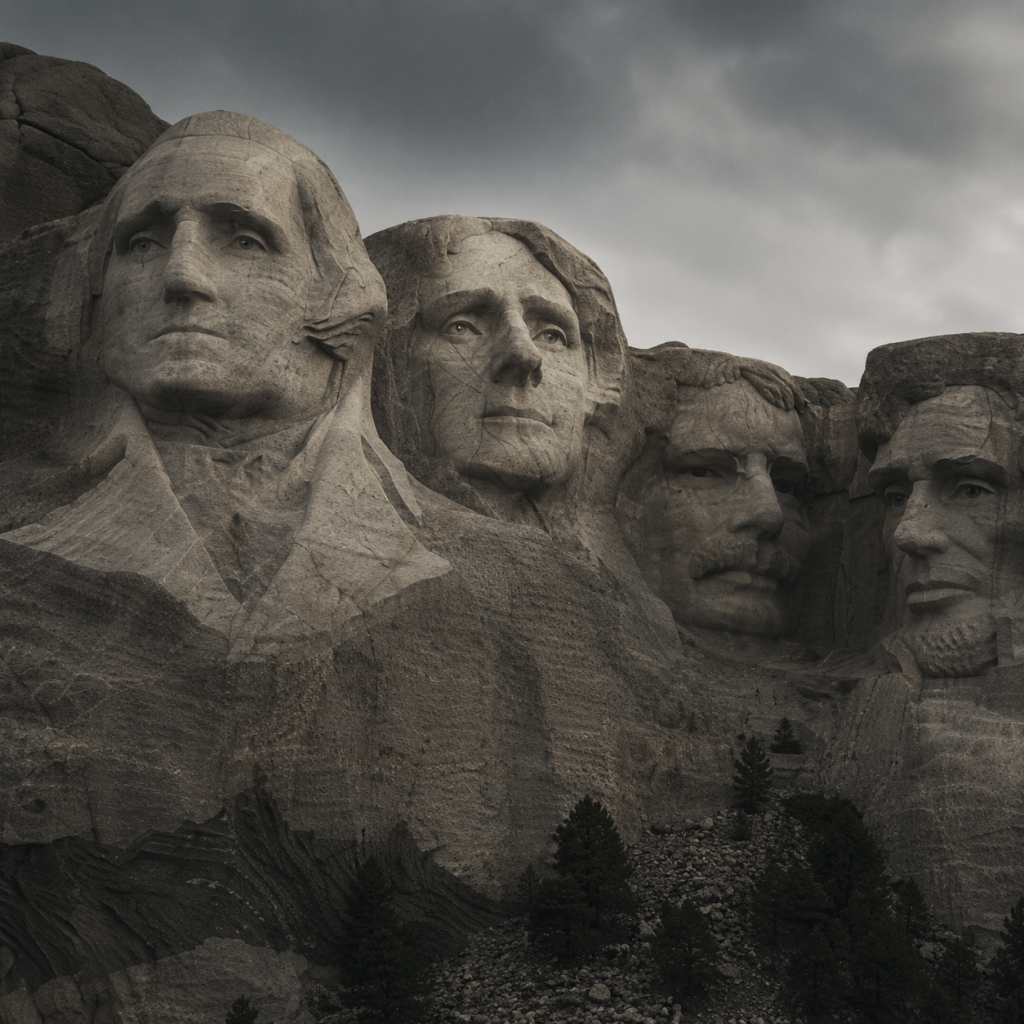
Take, for example, two of the Founding Fathers enshrined on Mount Rushmore. George Washington and Thomas Jefferson were not marginal men in the American imagination. They were giants of the founding generation who helped shape the republic in ways few men ever have.
But moral innocence is not the same thing as historical importance.
A man who knowingly holds human beings as property, profits from their forced labor, separates families, and refuses repentance is not merely an imperfect Christian with a few rough edges.
He is a man living in grave, public, scandalous sin.
In a biblically faithful church, such a man would not be qualified for office. He would not be considered for elder or deacon.
More than that, if he persisted without repentance, the question would not be whether he could lead a faithful local church, but whether he could be received into one at all.
Christians would do well to contemplate the severity of that distinction: men carved into the mountain of national memory, yet not fit, apart from repentance and true faith, to be received into membership in a biblically faithful local church.
So far is the nation-building project, with all its honor and glory, removed from the kingdom of God, which the church bears witness to.
That is the point many American Christians seem desperate not to face.
And this is not a complicated Reformed point.
The church is not a society for the civilly respectable. It is a gathering of sinners saved by grace. But saved sinners are called to repentance. And in a faithful church, the true preaching of the Word, the right administration of the sacraments, and the faithful exercise of discipline are not decorative ideals. They are the marks of the church. A church that knowingly blesses open, scandalous, unrepentant sin is not being merciful. It is betraying its own confession.
American chattel slavery was not a private weakness hidden in the recesses of the heart. It was public, legal, profitable, defended, inherited, expanded, theologized, and protected by men who knew enough moral truth to speak beautifully about liberty while blatantly denying it to others.
That is the scandal.
Not that the founding generation was imperfect. All men are imperfect.
The scandal is that so many Christians want to treat the moral catastrophe of slavery as though it were merely one unfortunate blemish on otherwise Christian statesmanship.
It was more than a blemish.
It was blood in the foundation.
That does not mean every accomplishment of the founding is erased. It does not mean the Constitution has no wisdom. It does not mean the republic produced nothing good. It does not require us to flatten history into childish categories of pure heroes and pure villains.
But it does require us to speak honestly.
Greatness of achievement is not the same thing as greatness of moral character.
God may bring temporal goods through deeply compromised men, but providence is not absolution. Consequence is not Christian character. Usefulness is not holiness. And worldly honor — even having one’s face carved into stone — does not remove one iota of guilt before God.
That distinction should not be difficult for Christians.
And yet it seems to be very difficult.
The difficulty is not usually found in what Christians formally confess. It is found in what we instinctively defend.
It appears when moral clarity about slavery is treated as ingratitude or lack of patriotism; when criticism of the founding generation is received as hostility toward the nation itself; when Christians grow more defensive for the reputation of dead statesmen than for the enslaved image-bearers those statesmen held in bondage.
It appears when “historical complexity” becomes a solvent strong enough to dissolve moral judgment.
That is where the confusion lives.
Not always in our formal doctrine, but in our reflexes. In our loyalties. In the sins we rush to contextualize. In the men whose sins we cannot bear to judge too plainly. In the national myths we preserve even when they require us to speak softly about evils Scripture condemns loudly.
This confusion is not merely historical.
It is happening now.
The same instinct that cannot bear to speak plainly about the moral failures of the founding generation is alive and well in the modern evangelical imagination. Too many Christians have trained themselves to excuse grave moral corruption when it is attached to political usefulness. They know how to say, “Yes, yes, he was flawed,” and then proceed as though the flaw hardly matters because the man served their political cause.
Political usefulness is treated as though it were advancing Christian witness. Victories against political opponents are counted as though the Kingdom of God depended on them. Moral clarity is dismissed as naïveté by those who have mistaken compromise for wisdom.
But when compromise crosses into moral witness, the church is not permitted to judge as the world judges.
The church must remember differently.
Give thanks for whatever good God, in His providence, has brought through this nation: ordered liberty, constitutional restraint, inherited freedoms, and the sacrifices by which many of those goods were preserved.
But do not let gratitude train you to call evil complicated when Scripture calls it evil.
Do not let patriotism make you gentler with slaveholders than you would be with an unrepentant sinner seeking membership in your own church.
Do not let nation-building projects and political allegiances blur your mind about what is truly kingdom work.
And do not mistake the preservation of a national myth for the defense of truth.
Mature disciples can remember with gratitude and sober judgment at the same time.
Those who bear the name of Christ in sincerity and truth should do so.
Because moral standards are not dimmed merely because the darkness of an age is more widely shared.
And Christ does not need our national myths in order to remain Lord.


Leave a Reply